Used as a place of worship from the Second Iron Age through late antiquity, Grotta Tanaccia yielded votive offerings and more than 100 coins.
A small place with a long history
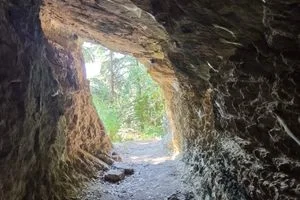
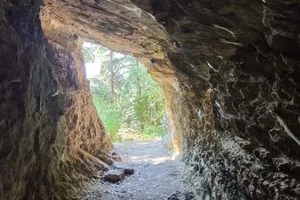
Grotta Tanaccia is a modest rock niche on Monte Titano, just outside San Marino’s city walls near Montale Tower. Its physical scale can make it easy to underestimate. The site’s importance comes from the span of time in which people used it as a sanctuary: worship there dates from the Second Iron Age through the Roman and late-antique periods. It’s identified as the republic’s oldest known sanctuary.
That description carries two distinct ideas. One is that the niche served a religious purpose over a long period; the other is that it holds a particular place in what’s currently known about San Marino’s past. “Oldest known” is an archaeological qualification, not a claim that no earlier religious activity ever took place in the area. It describes the evidence identified so far, and the limits of what surviving material can establish.
A sanctuary needn’t have been a grand building to matter to the people who visited it. Grotta Tanaccia’s modest form suggests that the story here isn’t one of monumental architecture. Instead, the evidence points to a place whose meaning was carried through repeated acts of worship and the objects left behind. A small site, used across generations.
What the finds can tell us
Excavations uncovered bronze votive objects, terracotta offerings shaped as arms and fingers, and more than 100 coins. These finds offer different kinds of evidence. Votive objects were dedicated in a religious setting, while the shaped terracotta pieces connect the site’s ritual life with representations of parts of the human body. The coins add another group of objects to the record, though their presence alone doesn’t explain exactly how each was used or why it was left there.
That distinction matters. Archaeological objects can show that people returned to a place and deposited items, but they don’t automatically preserve the thoughts or intentions behind those actions. A figure shaped like an arm or finger may invite questions about what worshippers sought, yet the objects described here don’t provide a complete account of individual prayers or beliefs. The evidence is tangible; its meaning still requires careful interpretation.
The mix of bronze, terracotta and coinage also gives the site a material record broader than any single offering. Each object type has its own qualities and may have played a different role in the life of the sanctuary. Taken together, the finds support the account of extended ritual use. They don’t, by themselves, supply a detailed chronology of every visit, change in practice or community that used the niche.
More than 100 coins may sound like a straightforward measure of activity, but quantity isn’t the same as a full explanation. Without further detail about their dates, arrangement or context, it would be misleading to assign them a specific pattern of use. Their value here is as part of the excavated evidence, alongside the other offerings, rather than as a ready-made narrative.
Continuity across changing periods
The sanctuary’s use is described as extending from the Second Iron Age through Roman and late-antique periods. Those labels cover broad stretches of history, and the important point is the continuity implied by the sequence. The site remained part of religious life across periods that archaeologists distinguish from one another. That doesn’t prove that beliefs or ceremonies stayed identical. A sanctuary can retain significance while the people using it, and the practices they bring, change.
This is more significant than it looks. A lasting religious site can offer a different kind of historical evidence from a single deposit or isolated artefact: it gives researchers a place to consider how ritual activity persisted through time. At the same time, the available description is careful about what it establishes. It identifies a long span of use and a collection of offerings, but doesn’t claim an unbroken institution, a fixed set of rites or a single community spanning all those periods.
That caution is useful. Archaeological accounts can be made to sound more certain than the evidence allows when objects are treated as direct illustrations of a complete story. Grotta Tanaccia’s finds are valuable precisely because they’re concrete, while their interpretation still has boundaries. The gap between an object and the person who left it is part of the history, too.
Why the museum matters
The excavated objects are now held at the State Museum of San Marino. Keeping them in a museum gives visitors and researchers a way to encounter material evidence associated with the sanctuary beyond the site itself. It also brings separate objects into a shared historical context: bronze offerings, terracotta forms and coins can be understood as parts of the record of one place.
A museum collection can preserve objects, support their study and make them available for public interpretation. It can’t restore every detail of the setting in which they were found, or answer questions the surviving evidence doesn’t settle. For that reason, the connection between the collection and Grotta Tanaccia matters. The objects tell more when their origin and the sanctuary’s long use remain part of the account.
For readers, that connection makes the site easier to understand than a list of artefacts alone would. The coins and offerings aren’t simply old things gathered in one place; they’re evidence associated with a specific niche on Monte Titano and a long history of ritual use. (And this is the part most people overlook.) The modest setting is central to the story: the sanctuary’s importance doesn’t depend on its size.
What Grotta Tanaccia signifies
Grotta Tanaccia offers a focused view of the past rather than a complete portrait of it. Its location near San Marino’s city walls and Montale Tower places it within a recognizable local setting, while the excavated offerings connect that setting with religious practice across several historical periods. The site’s designation as the republic’s oldest known sanctuary makes it a significant point of reference, but the evidence still speaks most clearly about what was found and the span of use that has been identified.
If you’re working in archaeology, heritage or local history, the site’s appeal is also a reminder to distinguish between duration and certainty. A long sequence of use can be compelling without proving that every generation understood the place in the same way. The objects provide a basis for further study, and their careful interpretation can deepen the account without turning unanswered questions into facts.
Grotta Tanaccia’s story rests on a simple but meaningful combination: a small rock niche, offerings left there, and evidence of worship extending across distinct periods. Its record isn’t exhaustive. Still, it shows how a place without monumental scale can hold enduring importance in the history of a community.

Discussion
Sign in to join the discussion.