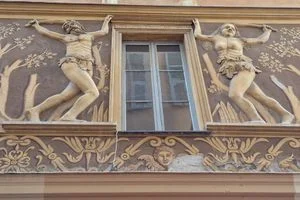
The Adam and Eve House, dating back to 1584, showcases exceptional sgraffito artistry and is a rare architectural gem in Nice.
Historical Context of the Adam and Eve House
The Adam and Eve House, located at 8 rue Poissonnerie, embodies a significant slice of history. Built in 1584, it stands as one of the rare painted houses from the late Renaissance era still preserved in Nice. This period was marked by a revival of classical art and architecture, with a particular focus on ornamentation and dramatic façades. Houses built during this time often served dual purposes: they were functional living spaces and elaborate statements of wealth and culture. And Nice, with its strategic Mediterranean location, was a melting pot of influences from neighboring Italy, resulting in a unique architectural style.
The late 16th century was also a time of considerable social and political upheaval in Europe, which is reflected in architecture of the era. In France, the Wars of Religion were ongoing, which influenced artistic expression and led to the emergence of a more vigorous style as builders sought to instill pride and stability in the wake of conflict. Thus, the Adam and Eve House doesn't just showcase craftsmanship but serves as a lens through which we can understand the socio-political climate of its time.
Architectural Style and Techniques
The façade of the Adam and Eve House is striking, principally due to its use of a decorative technique known as sgraffito. This method was particularly popular in Italy during the 15th and 16th centuries, spreading slowly into France and other parts of Europe. Sgraffito involves applying layers of differently colored plaster onto a damp surface, allowing artisans to carve intricate designs into the top layer, revealing the contrasting color underneath. This technique not only added depth but also allowed for varied artistic expression, making each façade unique.
While many contemporary buildings prioritize functionality over aesthetics, the splendor of this technique illustrates a dedication to beauty that characterized that period. Cities, especially those like Nice with a rich history of trade and culture, saw a variety of artistic expressions. The use of sgraffito here elevates the Adam and Eve House, making it a showcase not just for the architectural style of the time but also for the skill of local artisans who were well-versed in classical techniques.
Symbolism and Interpretation of the Artwork
As for the artwork depicted on the façade, there's a compelling duality to its interpretation. While many visitors and historians interpret the imagery as a representation of Adam and Eve in the Garden of Eden, local folklore spins a different narrative. According to some tales, the vibrant figures portrayed are not merely biblical archetypes, but rather the fiery inhabitants who once lived in the house when it was newly decorated. This blend of legend and artistic interpretation adds a rich layer of meaning to the structure, making it more than just a visual delight.
What this means for you, the observer or the academic, is that the Adam and Eve House serves a dual role. It is a testament to the artistry of its creators and also a reflection of societal norms and beliefs of the time. The interpretations around the artwork provide insight into local culture; they clarify how people inserted their lives into broader narratives. That's a perspective that's often overlooked in architectural history, where the focus tends to be more on technique and less on the human experience embedded in art.
Preservation Challenges
The preservation of historic buildings like the Adam and Eve House is crucial, yet it comes with its own set of challenges. Environmental factors such as pollution, weather, and age can wreak havoc on ornate façades. Local governments and heritage organizations often struggle to balance modern needs with preservation efforts. While many areas might call for renovations to modernize buildings, this might compromise their artistic integrity.
Efforts to preserve the Adam and Eve House must consider not only the structural aspects but also the artistic value of the sgraffito techniques used. Modern restoration practices frequently prioritize materials that might not align with those used in the original craftsmanship. The result? A potential disconnect between past and present, where a building loses its voice while trying to keep its stance intact. If you're working in this space or interested in architecture, these dynamics are central to the challenges of heritage management.
Implications and Future Outlook
The ongoing preservation of the Adam and Eve House offers valuable lessons in the intersection of history, art, and culture. As communities become increasingly aware of their architectural heritage, there's a growing movement aimed at preserving not just physical structures, but the stories they tell. This is more significant than it looks; the house is a case study in how local narratives can be interwoven with larger historical contexts, enriching both local and tourist experiences.
Looking ahead, there's an opportunity to foster greater public interest in heritage conservation through educational outreach and advocacy. Artists, historians, and local citizens can collaborate to ensure that such monuments aren't merely viewed as relics, but as living stories that connect past and present. This collaborative approach could help ensure that the Adam and Eve House continues to spark discussions about art, history, and community identity for generations to come.
In essence, the Adam and Eve House is not just a significant architectural marvel. It’s a dialogue between various eras—what it represented then and what it signifies today. There’s a powerful story hidden behind those walls, one that speaks to the generations that lived, loved, and thrived in this coastal city.



Discussion
Sign in to join the discussion.