A courtyard memorial, a reconstructed ghetto house and the “3000 fates” exhibit trace the lives and deaths of Jews in wartime Riga.
A museum rooted in place
The Riga Ghetto and Latvian Holocaust Museum makes its strongest case through place and testimony. Opened in 2010 by the Shamir religious community with support from Riga City Council, it stands in Spīķeri, near the Latgale district and the site of the former Jewish ghetto. That location gives the museum a direct relationship to the history it presents: visitors aren't encountering the subject only through objects in a gallery, but in an area connected to the events themselves.
Place can make a history easier to grasp, though it can't explain that history on its own. A museum has to connect the setting to the people who lived through it and to the systems that persecuted them. Here, the courtyard and the records inside it work together to make that connection. The effect is restrained, but it gives the visit a clear point of reference.
Marking the ghetto and the dead
The courtyard recreates the ghetto’s barbed wire perimeter and cobbled streets. These features offer a physical frame for thinking about confinement and daily life, without making the reconstruction a substitute for the historical record. A memorial wall records nearly 70,000 Jewish victims who died in Latvia during World War II, including both Latvian Jews and people brought from abroad. The number and the distinction matter: the history presented here reaches beyond the local community, while remaining tied to what happened in Latvia.
A railway carriage, marked with the European locations from which victims were deported to Riga, adds another kind of evidence. Its form points to transport and displacement; the locations connect that movement to places across Europe. Together, the carriage and memorial wall make the scale of persecution visible through objects and names of places rather than through an elaborate display. The facts are stark enough to carry the weight.
Personal histories on display
Photographs of murdered Latvian Jews and the ghetto line one wall; another documents concentration camps and mass executions by the Einsatzgruppen, the SS death squads. The arrangement places individual lives alongside the wider machinery of violence. That pairing is important because large totals can become abstract, while photographs and documents bring the record back to people and specific histories. The displays ask visitors to hold both scales in mind.
Nearby, a restored green wooden house once stood inside the ghetto. Its cramped rooms show the harsh conditions residents endured during the war. The house gives visitors a way to consider how restriction shaped ordinary surroundings, not just the boundaries marked in the courtyard. It’s a modest setting, and that modesty helps the evidence remain central.
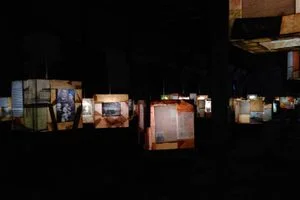
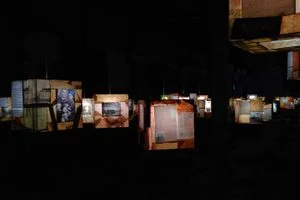
One former factory building contains “3000 fates,” an installation of illuminated wooden cubes holding photographs and records of Czech Jews deported from the Terezin Ghetto to Riga. Of roughly 3,000 people transported, only 128 survived. The installation’s repeated cubes make the group visible one person at a time, while the survival figure gives the display a sobering scale. This is more significant than it looks: the format makes room for individual records within a history that can otherwise be reduced to a single number.
And yet, no arrangement of photographs or records can restore the lives that were taken. The value of an installation like this lies in preserving traces and making them available to visitors, not in pretending that display can resolve the loss. The illuminated cubes offer a quiet, cumulative encounter. One record, then another.
A deliberately restrained visit
Interactive displays are limited. The museum instead relies on its courtyard, objects and documentation to convey the scale of persecution and the lives caught within it. That choice puts the emphasis on the evidence itself, leaving visitors with a direct sense of Riga’s wartime history. It also asks for patience: the experience depends on looking closely and making connections across different kinds of material.
That restraint has a clear strength. Visitors aren't pushed through a heavily mediated account when the physical setting, photographs and documents already supply substantial context. But a quieter approach also places more responsibility on the displays to make relationships between events, places and people legible. If you're working in this space, that balance will feel familiar: interpretation needs to guide attention without crowding out the source material.
Here's the thing: a museum’s impact isn’t measured only by how much technology it uses or how many interactive features it offers. The Riga museum’s account depends on its proximity to the former ghetto, the objects it presents and the records it preserves. That combination gives the visit a grounded focus, even as the limited use of interactive displays means the experience may ask more of visitors who want additional explanation.
What the museum leaves with visitors
The museum’s strongest contribution is the way it connects a specific place in Riga with a history extending across Latvia and Europe. The courtyard establishes the setting; the memorial wall, railway carriage, house and “3000 fates” installation each add a different kind of evidence. None can tell the whole story alone. Taken together, they give visitors several ways to understand how deportation, confinement and mass murder entered individual lives.
Its restrained presentation also shapes what visitors may carry away. There’s no need for a dramatic effect when the records and surviving spaces already convey the severity of what happened. The harder question is how to keep attention on both the enormity of the crime and the identities behind the totals. This museum’s answer is direct: return visitors to the place, the documents and the people they represent.
Discussion
Sign in to join the discussion.