Madrid’s punk venue Gruta 77 turned rescued shop signs into a tribute to local businesses as Carabanchel changes and the club faces a 2026 closure.
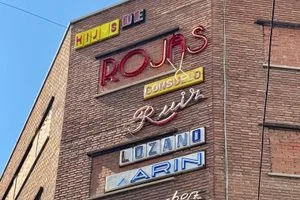
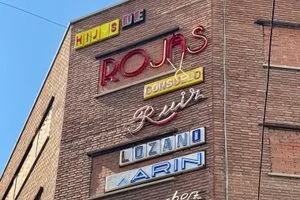
Gruta 77’s façade tells two stories about Carabanchel: the history of Madrid’s small businesses and the uncertain future of one of its best-known punk venues. A gathering place for rock fans, musicians and rehearsal bands for almost 30 years, the club is expected to close at the end of 2026. The building’s exterior now puts those stories side by side, making a local music venue serve as an informal record of shops and bars that have vanished elsewhere in the city.
That combination gives the façade a meaning beyond decoration. A music venue is usually understood through what happens inside: performances, rehearsals and the everyday work of bringing people together around music. Here, the outside carries its own account of local change. It points to the businesses that once served residents, while the club itself stands as a reminder that cultural places can become vulnerable as the neighborhoods around them change.
Shop signs on a punk venue
Since 2022, the venue’s exterior has displayed Hijas de Rojas, an installation of vintage signs salvaged from businesses that have disappeared from Madrid’s streets. The collection includes the blue-and-white sign of Bar Lozano, which served Malasaña from 1975 to 2018. Madrid collective Paco Graco recovered and preserved the signs, turning Gruta 77’s façade into a record of the neighborhood businesses and families behind them.
A shop sign is a modest object, but it can hold several kinds of information at once. Its name and design identify a business; its wear and materials suggest that it belonged to a working place rather than a museum display. When such signs are kept in public view, they preserve traces of ordinary commercial life that are easily lost when a business closes and its premises change hands.
The installation also shifts the signs from their original setting. Bar Lozano’s sign came from Malasaña, while it now appears on a venue in Carabanchel. That movement connects different parts of Madrid through the experience of disappearing local businesses. The signs don’t make those businesses present again, and they can’t explain every reason a shop closed. They do make the loss visible, which is a useful first step in thinking about what a neighborhood keeps and what it leaves behind.
Here’s the thing: the project’s setting matters as much as the objects themselves. A punk venue is a working cultural space, with an audience and a role in its neighborhood, rather than a neutral wall for historical material. Putting old commercial signs there creates a conversation between two forms of local life: the shops that serve a street and the venue that gives people a place to gather. (And this is the part most people overlook.) The display is about continuity as well as disappearance.
Carabanchel’s changing identity
The installation carries added weight as Carabanchel changes. Limited housing and rising prices are reshaping the barrio, alongside an influx of residents, businesses and development. For longtime locals, Gruta 77 is part of the area’s alternative cultural identity, not simply a place to hear live music. Its expected departure in 2026 would leave that identity with one fewer home.
Neighborhood change is often described through visible signs such as new businesses, construction and shifting housing costs. Those changes can bring new services and new residents, while also putting pressure on the places that give longtime residents a sense of familiarity. The effects aren’t evenly experienced: a new address on a map may represent opportunity for one person and the loss of an established meeting place for another.
Music venues occupy a particular position in that process. They need a physical space, regular audiences and the practical ability to host performances and rehearsals. Their value can be difficult to capture in a simple account of property or business activity, because much of it lies in repeated use: bands practicing, performers meeting audiences and people returning over time. A venue’s cultural role accumulates through those routines.
Gruta 77’s long presence gives its possible closure a specific meaning in Carabanchel. It has served rock fans, musicians and rehearsal bands for almost 30 years, according to the source. That history doesn’t make the club immune to the pressures affecting the barrio, but it explains why its expected departure is understood as more than a change in entertainment options. A place can become part of a neighborhood’s identity precisely because people use it for years, not because it was designed to symbolize anything.
What the signs can and can’t preserve
Preserving a sign is not the same as preserving the business that once used it. The people who ran a shop, the customers who relied on it and the relationships formed there can’t be transferred along with a piece of lettering. Still, objects like these offer a tangible link to that history. They can prompt residents to remember a place and give newcomers a glimpse of the commercial life that preceded them.
That distinction is useful when considering Hijas de Rojas. The installation makes vanished businesses part of the present, but it doesn’t reverse their disappearance. Nor does the presence of the signs settle the question of what will happen to Gruta 77 after its expected closure. The display’s force comes partly from that uncertainty: it asks viewers to consider how a neighborhood records change while the places shaping its current identity may themselves be at risk.
This is more significant than it looks. A façade can’t solve rising housing costs or guarantee the survival of a venue, but it can make change legible at street level. The signs invite passersby to see a business district as more than a succession of storefronts. Each storefront belongs to a larger pattern of work, family life and local memory.
The significance of an expected departure
The stated timetable gives this story a horizon: Gruta 77 is expected to close at the end of 2026. That’s a forecast about the venue’s future, not proof that every detail of what comes next is settled. For now, the club remains a gathering place, and its façade continues to hold the signs. The gap between an expected closure and the present is also a period in which the venue’s history can be recognized and its role in Carabanchel considered.
If you’re working in music or local culture, Gruta 77’s story offers a familiar question: what does a neighborhood lose when a long-running space disappears? The answer isn’t limited to its stage or rehearsal rooms. It may include the habits and connections that formed around them. Those effects are hard to measure, but they’re easy to overlook when change is discussed only as a shift in residents, prices or businesses.
And yet, the signs point to a broader challenge. Cities can preserve objects from their past even as the places that give daily life its texture continue to change. The display at Gruta 77 brings that tension into view without pretending to resolve it. A sign survives. A venue may not.
For Carabanchel, the question is how its alternative cultural identity will be carried forward if one of its best-known punk venues closes as expected. The source doesn’t establish what will replace Gruta 77, or whether another space will take on a similar role. What it does show is the value attached to the club by the people who see it as part of the barrio, and the way a collection of rescued shop signs can make that value easier to read from the street.
Discussion
Sign in to join the discussion.