Reopened in April 2025, Barryscourt Castle combines medieval architecture, battle scars and a rare trace of Ogham graffiti.
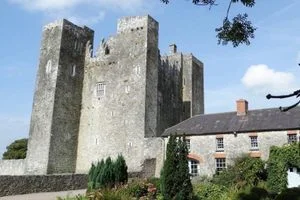
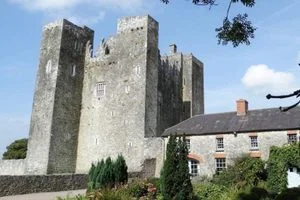
Barryscourt Castle’s history is written into its fabric: cannon marks scar the masonry, a fireplace inscription records a 16th-century rebuild, and Ogham graffiti appears in a chapel painted with vivid pigments. After closing in 2016 for conservation, the castle reopened to visitors in April 2025. Its return offers a rare chance to read these layers in the building itself, where repairs and adaptations sit alongside the marks of conflict. This is more significant than it looks: at a historic site, the building can preserve evidence that written records leave out.
A seat shaped over centuries
Located just outside Carrigtwohill in County Cork, Barryscourt became the principal seat of the Barrymore branch of the Anglo-Norman Barry family. Heritage Ireland dates the surviving castle chiefly to 1392–1420, during the tenure of John Ciotach Barry, the family’s seventh Lord Barry. The family’s presence in the area, and occupation of the site, extend further back; the present structure reflects repeated changes in use and circumstance. That distinction matters: the date of the surviving fabric doesn't mark the beginning of the site’s story.
The castle is a fine example of an Irish tower house. Its central tower stands within a walled bawn, an enclosed courtyard reinforced by corner towers. Inside were rooms for everyday life and ceremony, including a Great Hall, kitchen, private chambers and chapel. The layout brought domestic routines and defensive planning into one compact complex. Archaeological evidence also points to changing priorities: the bawn, first part of the castle’s defensive layout, was later cultivated as a garden. A space designed for protection became useful for cultivation, a practical shift that speaks to how the castle was inhabited as conditions changed.
Conflict and domestic life in the walls
Barryscourt’s stones preserve evidence of the upheavals that reached Cork in the 16th and 17th centuries. The Barrys were drawn into the Desmond Rebellions, and English forces under Sir Walter Raleigh threatened the castle. Parts of the building were deliberately damaged to keep them from enemy use. The site was attacked again during the Irish Confederate Wars; cannon-ball damage remains visible in the masonry. These marks make conflict tangible, but they don't tell the whole story: damage, repair and later use all belong to the same structure.
A quieter marker of the castle’s life appears above a fireplace. Its inscription records that David Barry and Eleanor Roche rebuilt the castle in 1588. It anchors the building’s history in family life as well as conflict: Barryscourt was a home that was repaired and adapted over generations. A named rebuilding effort also gives visitors a rare point of human connection in a place otherwise encountered through stone, rooms and fragments of evidence.
Ogham in a medieval chapel
Conservation work uncovered traces of coloured wall painting in the small domestic chapel, with red, yellow, orange and black pigments. Incised designs include human and animal figures, boats and a section of Ogham script. The combination makes the chapel more than a decorated room: its walls preserve several forms of expression, though the evidence doesn't identify their makers.
Ogham is most often associated with early medieval Irish stone monuments and inscriptions from the first centuries of Christianity. At Barryscourt, it appears within a much later building. The marks are generally understood as graffiti, sometimes called domestic graffiti, rather than a formal inscription. Their presence leaves open questions about who made them, what they meant and how knowledge of Ogham persisted into the 16th century. The uncertainty is part of the evidence. A mark can establish that someone used the script here, while leaving the purpose and circumstances unresolved.
Conservation brings the castle back
After a long decline, the castle received restoration work under Dúchas in the 1990s, including repairs and a new roof for the tower. Water ingress, damp and electrical issues later prompted its closure to visitors in 2016. The Office of Public Works then carried out a major conservation programme, repairing masonry, upgrading heating and fire systems, and restoring the gardens and visitor facilities. The sequence shows how maintaining a historic building involves more than stabilising its visible stonework: moisture, services and visitor access all affect whether it can remain open.
The work included hand repointing more than 17 kilometres of stone façade with traditional lime mortar. Crews also filled concealed voids within the walls with liquid lime grout. Those methods address the building at different scales, from exposed joints to hidden gaps. The castle reopened in April 2025, giving visitors access again to its halls, chapel and chambers. That access lets people encounter the conservation work alongside the older evidence it was intended to preserve.
What the reopening makes possible
The appeal lies in how these details sit together: the defensive courtyard turned garden, the family’s rebuilding record, battle damage and Ogham marks on chapel walls. Barryscourt offers a close view of a building continually reshaped by the people who lived in it—and whose small, unresolved traces still invite questions. Here's the thing: the site’s value doesn't depend on every mystery being solved. Its layered evidence gives visitors a way to consider how a castle could serve as a home, a fortified seat and, later, a place shaped by conservation.
If you're working in heritage, Barryscourt also offers a clear reminder that access and preservation are tied together. Conservation can make a site usable again, but it must contend with the very fabric that makes the place worth visiting. And yet. The reopened rooms and gardens bring people closer to that history, while the Ogham marks remain a useful check on any tidy account of the past. (And this is the part most people overlook.) A restored castle can be easier to visit without becoming easier to interpret.


Discussion
Sign in to join the discussion.