Gallery O on H pairs self-taught art and salvaged objects with Washington history across interconnected rooms and courtyards.
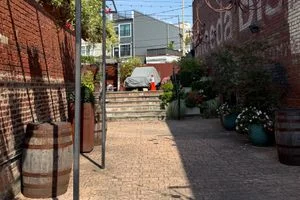
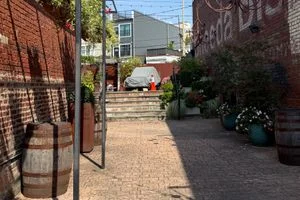
Gallery O on H makes its strongest impression through the way it brings art and place together. Behind the modest row-house facades on Washington, D.C.’s H Street, connected galleries, rooms and courtyards turn a visit into a search for work that might appear around any corner. The architecture shapes how you look: instead of meeting a sequence of objects in one open room, you move among different settings and discover how each work sits beside the next. That makes the gallery feel less like a neutral container and more like part of the collection itself.
The space has been part of the H Street corridor for more than 15 years. Its collection favors self-taught artists, especially those linked to New Orleans, and gives discarded materials a central role. Paintings and sculptures share space with found objects and fragments of local history, making the setting feel closer to an assembled archive than a conventional gallery. An archive usually asks visitors to connect separate pieces of evidence; here, that work belongs to the experience, too. A painted surface, a found object and a historical artifact can each carry a different kind of memory, and their proximity encourages you to compare them.
Art made from what others leave behind
Some of the collection’s most distinctive works begin with ordinary or salvaged materials. New Orleans artist Dr. Bob Shaffer started painting discarded folding chairs after Hurricane Katrina. Six chairs at Gallery O on H have grown into a group of 75, depicting New Orleans musicians and traditions alongside H Street and its residents. The shift from one chair to a larger group gives the project room to move between places and subjects: the chairs hold images of a city’s cultural life, while the H Street works bring that attention back to the neighborhood around the gallery. The material matters, but so does the choice to make a familiar object carry a portrait.
Tennessee artist Danny Hoskinson, known as “The Bucket Man,” uses a blowtorch to reshape discarded plastic paint buckets as creatures, masks and sculptures. French artist Joanathan Bessaci cuts and layers vintage road maps into portraits of George Washington and Abraham Lincoln. New Orleans artist Sainte James Boudrot paints on salvaged wooden crate lids, using archival obituary notices to preserve stories of everyday people. These approaches have little in common as techniques, yet each starts with an object that already has a history. A bucket, a map or a crate lid arrives with a former purpose; the artists redirect that material and invite viewers to consider what else it can hold.
That transformation isn't automatically meaningful just because a material has been reused. What gives these works their force is the specific connection between the object and the subject: maps become portraits, and obituary notices make individual lives visible. The objects don't simply decorate the gallery. They carry evidence of use and time into the work.
The range extends beyond those materials. Charles Gillam carves portraits of New Orleans music legends, while Purvis Young paints Miami’s Overtown neighborhood and Ike Morgan depicts American presidents. Some artists represented here also have work in major museum collections, including the Smithsonian American Art Museum. That institutional recognition provides a point of reference, but the gallery’s character comes from the variety of practices gathered in its rooms. There are portraits, neighborhood scenes and sculptures, with no single medium defining the whole collection. The breadth is useful, though it also asks visitors to pay attention to the individual works rather than treating “self-taught” as a complete description of what they’ll see.
Washington history in an unexpected setting
A silver slipper from the original Silver Slipper nightclub adds a sharp piece of the city’s past. The Capitol Hill gathering place entered Washington lore in 1974, when burlesque performer Fanne Foxe—then having an affair with Congressman Wilbur Mills—jumped into the Tidal Basin after police stopped their car near the Jefferson Memorial. The slipper brings that episode into the gallery’s wider mix of art and historical objects. It works as a compact reminder that an object can outlast the setting and people connected to it, then acquire fresh meaning when it’s displayed elsewhere. Here, a piece of nightlife history sits among artworks rooted in other cities and communities.
There’s an element of surprise in that pairing. The slipper doesn't explain the surrounding art, and the art doesn't turn the historical object into a simple footnote. Instead, the collection makes room for different kinds of stories to sit beside one another (and this is the part most people overlook): the connections are often made by the visitor, not spelled out on a wall. A small artifact can shift your sense of what belongs in an art space. A record of public scandal, a portrait of a musician and a salvaged chair can all prompt questions about who gets remembered and how.
A visit shaped by discovery
Visitors encounter this material across the garage, courtyard and rooms rather than along a standard exhibition route. That arrangement is part of the appeal: Gallery O on H asks you to notice how paintings, castoffs and historical artifacts change meaning when placed together. The result offers a distinctly local portrait of artistic resourcefulness and Washington’s many layers. You may find that the route matters as much as the individual displays, since a work’s effect can change when you come upon it after seeing another room or crossing the courtyard. A pause, then a turn into the next space.
This is more significant than it looks. Galleries often ask visitors to follow an orderly sequence; Gallery O on H makes discovery part of the encounter, which can help familiar materials and local history feel newly present. If you're working in this space, the collection also offers a reminder that exhibition design can shape interpretation without dictating a single reading. That said, a visitor who prefers a clear route or a tightly focused exhibition may find the variety demanding. The gallery’s strength is its accumulation of stories, and its challenge is that those stories don't always resolve into one neat account.
What this means for you is simple: come ready to look closely and make connections. The work ranges across places, materials and forms of remembrance, with H Street providing the setting rather than a single theme tying every piece together. Gallery O on H is less a survey of one artistic movement than a place where the meanings of objects can change from room to room. Its most persuasive claim is also its quietest: what people discard, preserve or display can tell a story about the communities around them.



Discussion
Sign in to join the discussion.