Angst Yok’s fake official signs, “TUGENDAMT” and “PIZZARAND,” add humor to the fading, historic Dreilinden rest stop.
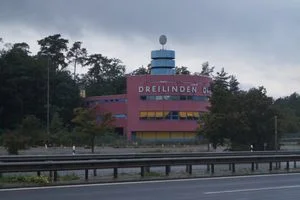
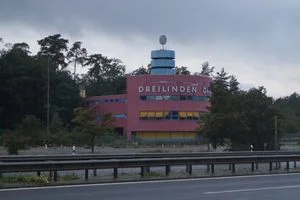
At the former Dreilinden rest stop, street art gives a fading border crossing a dry punchline. Large, official-looking signs rename its abandoned gas station canopies “TUGENDAMT” and “PIZZARAND,” turning a site marked by history and neglect into something unexpectedly funny. The joke works because the setting already looks like it belongs to another era: institutional buildings, empty forecourts and signs that still carry the authority of a place where drivers once had to stop. Here’s the thing: the artwork doesn’t need to explain the site’s past to make its present feel strange.
A monument left waiting
Built from 1968 to 1972, the Dreilinden complex was designed by Rainer Rümmler and Hans Joachim Schröder. Its clearance buildings, rest stop, two gas stations and customs bridgehouse form a vivid composition in red, blue and yellow—an unmistakable expression of 1970s design. The ensemble is now a listed historic monument. That status gives the complex a public value beyond its original function: its buildings document how architecture, traffic and border control were brought together in one working site. The result is more than a collection of old service buildings. It’s an unusually legible piece of infrastructure, planned to shape how people moved through a politically charged boundary.
Its present condition tells a less celebratory story. Paint has faded, yellow blinds hang askew and graffiti covers the former gas station buildings. The rest stop has recently been renovated, but remains unused; the gas stations are shut. Only the customs office in the bridge building is still active, and it too looks overdue for attention. That mixture of repair and neglect is hard to read as a finished plan for the site. A renovated building usually signals a return to use, yet here the visible work hasn’t brought the complex back to life. It’s a pause with no clear explanation in the scene itself.
That contrast matters because historic sites don’t maintain themselves simply by being protected. Their buildings need a purpose, or at least a credible plan for one, if restoration is to feel like more than a temporary improvement. Dreilinden’s empty facilities make that problem visible. The structures remain, but their original arrangement no longer serves the traffic patterns and border routine that gave them meaning. The monument’s physical presence is secure enough to be noticed; its future role is less apparent.
That decline sits against the site’s former role in the West Berlin border routine. Drivers once stopped for fuel before facing checks by East German border police, known as the Vopos. Outbound traffic slowed to a crawl, while the stop also drew hitchhikers. Today, motorists hurry past the area, often paying little heed to the 60 km/h speed limit around Checkpoint Bravo. The difference is more than a change in pace: what was once a place of enforced waiting has become a place people pass through quickly. The old layout still carries traces of that earlier purpose, even as its everyday use has largely disappeared.
For visitors, that shift can make the site feel oddly suspended. There’s enough left to suggest how it worked, but not enough activity to make the experience feel ordinary. The bridgehouse still anchors the complex, and the customs office remains active, yet the surrounding buildings are mostly reminders of functions that have fallen away. A border crossing is usually understood through movement and control; at Dreilinden, the empty spaces now make absence part of the story. And yet, the site hasn’t gone quiet in every sense.
Official signs with a joke inside
Between the old filling stations, a Berlin Bear stands on its pedestal, greeting people arriving along one of the city’s major roads. The bear seems almost to grin. Look up at the canopies and the reason becomes clearer: “TUGENDAMT” appears in white on the outbound side, while “PIZZARAND” is written in black on the inbound side. The signs borrow the visual confidence of public information, but their words send the viewer somewhere less official. That gap between appearance and meaning gives the work its edge. It doesn’t erase the seriousness of the location; it makes the setting’s authority available for a joke.
“Tugendamt” riffs on Jugendamt, Germany’s youth welfare office. The clocks on the gas station facades, all stopped at five minutes to twelve, add another note of unease to the scene. The wordplay is quick to grasp, but it also makes the canopy feel like a sign from a parallel version of public life: familiar in form, absurd in purpose. The clocks deepen that impression. They offer a detail that looks specific and deliberate, while their shared stillness suggests a place caught outside ordinary time. A small visual joke, with a darker aftertaste.
The signs are the work of Angst Yok, an artist collective that alters abandoned storefronts, billboards and other urban spaces with messages designed to look official at first glance. The effect lands somewhere between satire and wordplay, poking at consumer culture while giving passersby a reason to smile. At Dreilinden, that humor joins the site’s history, faded splendor and visible uncertainty about what comes next. The work also depends on its setting: removed from the old gas station canopies, the phrases would lose much of their force. Their polished, institutional look plays against a place whose original services have largely stopped.
What the artwork changes—and what it can’t
This is more significant than it looks. The signs give a neglected corner of the complex a fresh point of attention, but they don’t resolve the larger question raised by the empty buildings: what role can a former border facility play once its original purpose has passed? Art can make an overlooked place visible, and it can give visitors a reason to look twice. It can’t, by itself, provide the daily use that keeps a restored site active. That distinction matters at Dreilinden, where the contrast between renovation and vacancy is already part of the experience.
If you’re working in this space—whether you care about preservation, public art or the design of everyday infrastructure—the site offers a useful reminder that meaning doesn’t end when a building’s first function does. New uses often have to account for several layers at once: the architecture, the history attached to it and the practical needs of people who might enter today. There’s no single answer visible here. At present, the street art supplies a new layer without pretending to settle the others.
And that may be why the joke holds up. The signs aren’t a tidy explanation of Dreilinden’s past, nor do they turn abandonment into a charming backdrop. They make the uneasy combination of monument, working office and shuttered service area easier to see. The clocks remain stopped. The rest stop remains unused. For now, the artwork gives the place a voice, even as the question of what comes next stays open.


Discussion
Sign in to join the discussion.